
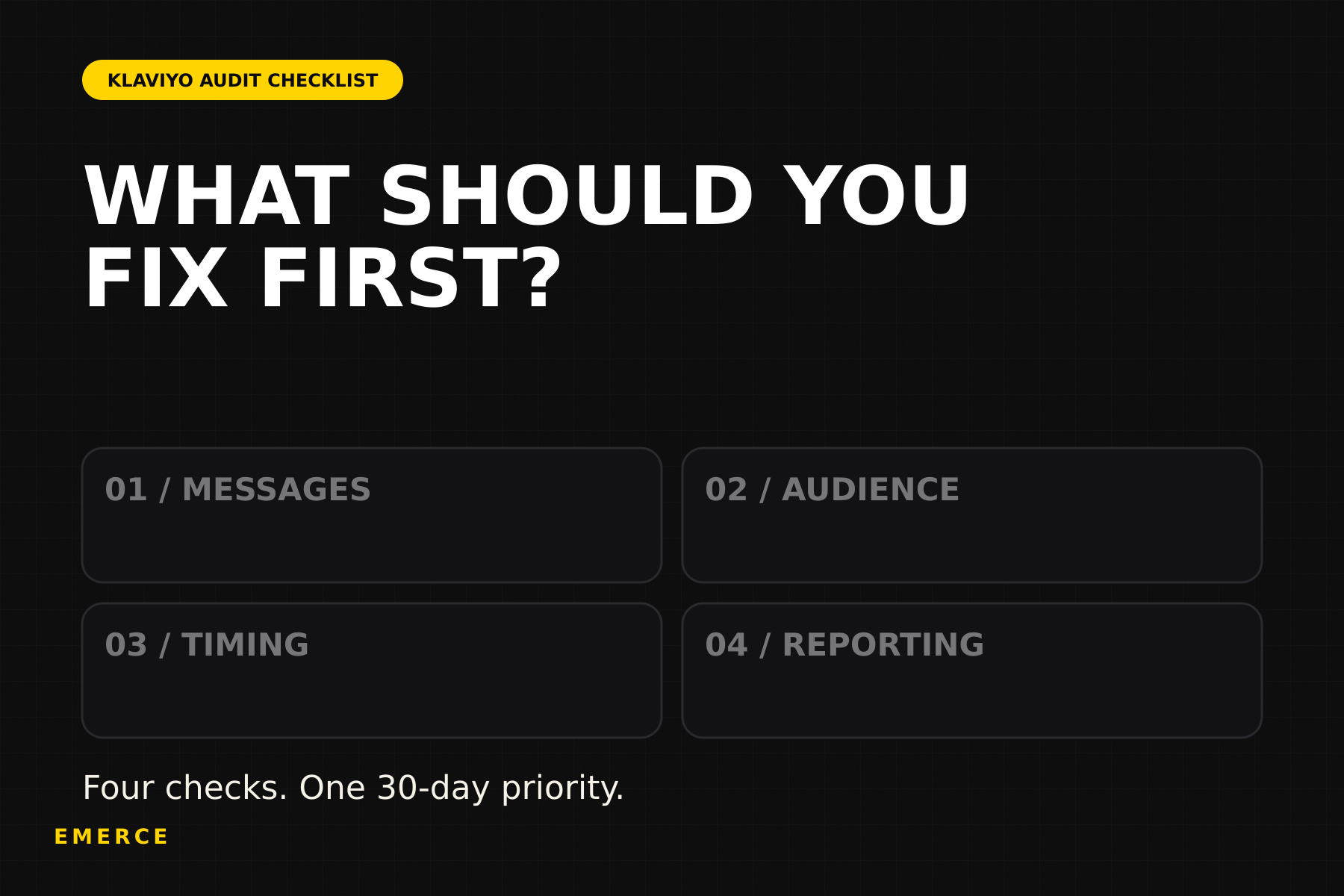
A Klaviyo audit can uncover dozens of problems. That part is easy.
The useful part is deciding what to fix first.
Review the account in four areas:
- What you send
- Who gets it
- When it arrives
- How you judge the result
Score each area from one to five. The lowest score becomes the main job for the next 30 days.
You can keep everything else on a backlog. It will still be there. Klaviyo is thoughtful like that.
Start with the business, not the dashboard
Before opening Klaviyo, write down what the business needs from email over the next 90 days.
Ask:
- Which products or categories matter most?
- Are you trying to win new customers, increase repeat purchases, or improve margin?
- Has traffic, inventory, pricing, or the offer changed?
- How often are campaigns meant to go out?
- What should flows handle automatically?
- Which reporting window and attribution settings will you use?
This stops the audit from rewarding tidiness for its own sake. A beautifully organized account can still send the wrong emails to the wrong people. Neat folders cannot save it.
1. What you send
Look at the last four to eight weeks of campaigns. Give each send a clear job.
For example, did it:
- Sell a product people already want?
- Explain why a product matters?
- Answer a common objection?
- Show proof?
- Help an existing customer get more value?
- Bring back someone who has gone quiet?
If nearly every campaign is another promotion, you do not have much of a content mix. You have the same email wearing different shoes.
Check whether the subject line, main message, products, proof, and CTA all support the same job. Then look for repetition. If the last five campaigns made the same argument, changing the hero image has not created a new idea.
Review flows the same way. Klaviyo flows can start from behavior, list entry, dates, or account data. The trigger tells you when a message can send. It does not tell you whether that message deserves to exist.
For each core flow, ask:
- What happened before this message?
- What does the customer need now?
- What should they do next?
- Does each step add something new?
- Is the flow live, measured, and maintained?
Score this area lower when campaigns repeat themselves, core flows are missing, or messages exist without a clear job.
2. Who gets it
Next, check who receives regular campaigns.
Someone being technically emailable does not mean they should receive every send. Look at clicks, purchases, website activity, and recency—not only opens.
Review:
- Your main engaged segment
- Recent buyers and product-specific exclusions
- People who have never clicked or bought
- Long-term inactive subscribers
- Consent and channel status
- Segments that overlap or contradict one another
- Whether different groups receive different content or frequency
Klaviyo recommends identifying people who are no longer engaging, excluding them from regular marketing, and suppressing profiles that remain unresponsive after an appropriate re-engagement process. That does not mean deleting everyone who had a quiet month. It means giving continued access to the inbox a reason.
Score this area lower when the whole list gets most campaigns, the engaged definition is vague, or inactive profiles stay in rotation because removing them makes the audience number look smaller.
3. When it arrives
The calendar only shows campaigns. Customers can also receive welcome emails, browse reminders, cart messages, checkout reminders, post-purchase emails, review requests, and SMS.
Each message may look reasonable on its own. Together, they can feel like the brand has become unusually needy.
Check:
- Campaign frequency for active, cooling, and inactive groups
- Campaigns and flows landing close together
- Repeated products or offers across messages
- Smart Sending or similar protections
- Times those protections are deliberately turned off
- Unsubscribes and complaints after busy periods
- Whether your best customers get enough useful contact
- Whether low-interest subscribers get less by default
The answer is not always fewer emails. Some customers should hear more. Others should hear much less. One list does not need one schedule.
Score this area lower when everyone gets roughly the same cadence or when you cannot see what one person received across campaigns and flows.
4. How you judge the result
A report should help you make a decision.
Start with:
- Click rate
- Conversion or placed-order rate
- Revenue per recipient
- Unsubscribe rate
- Spam complaint rate
- Bounce and delivery trends
- Results by audience and campaign type
- Flow performance by individual message
- Attribution settings and any recent changes
Open rate can stay in the review, but treat it as a clue. It cannot tell you whether the email earned a click, created an order, or made the next send harder.
When clicks are healthy but sales are weak, check the landing page, offer, inventory, and checkout. When revenue rises but unsubscribes rise sharply too, ask whether you earned the extra revenue or borrowed it from future reach.
Score this area lower when reporting stops at opens and total attributed revenue, mixes very different campaigns, or ends with no clear action.
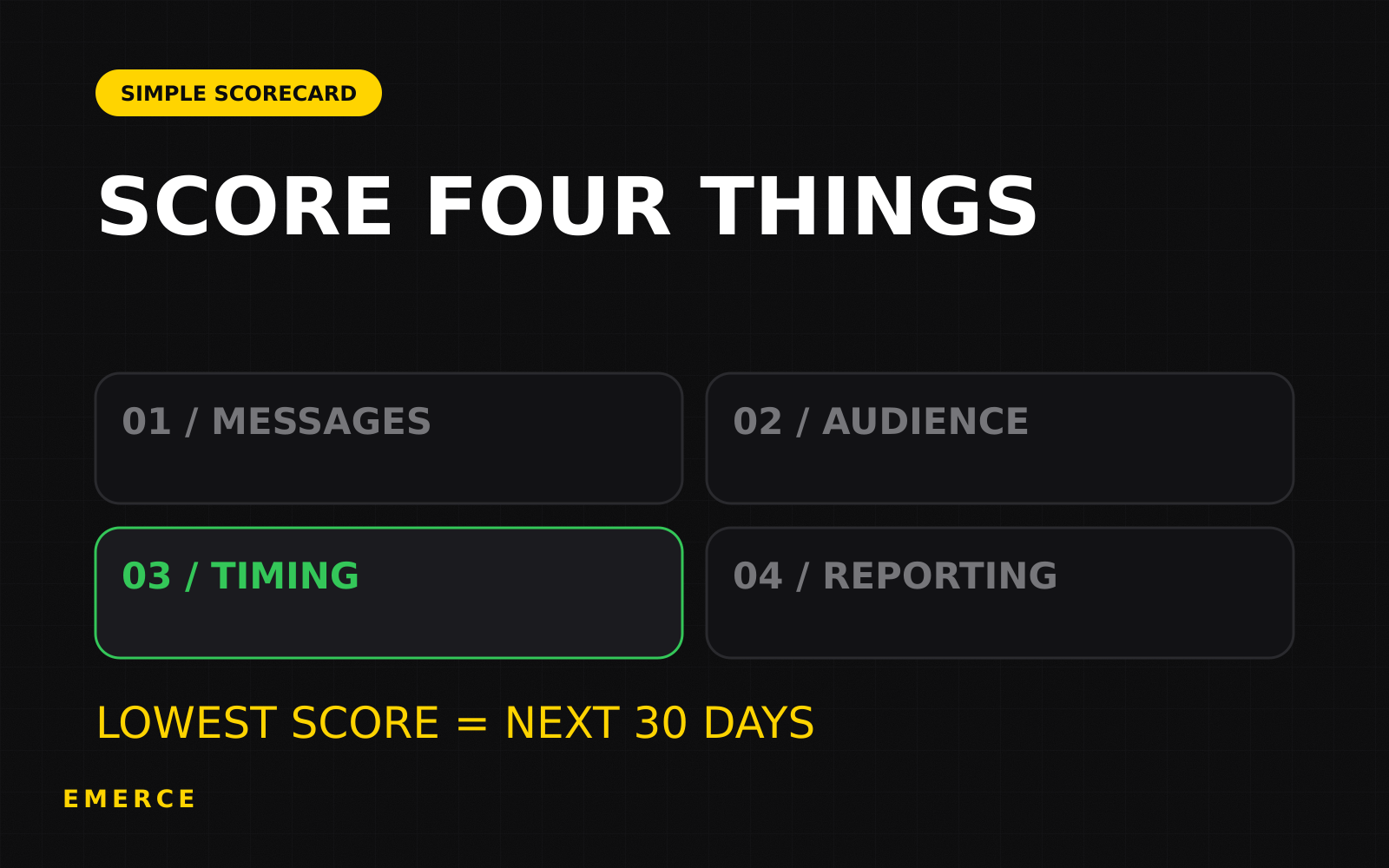
Use a simple scorecard
Score each area from one to five.
- 01
The basics are missing or unreliable
- 02
Major gaps are hurting performance
- 03
The area works, but important gaps remain
- 04
Strong, with a few clear improvements available
- 05
Clear, consistent, and measured
For every score, write down the evidence. “Feels weak” is not evidence. A repeated campaign idea, a missing flow, an overbroad segment, or a report that hides individual flow steps is.
Then ask:
- Which low score is costing the business most right now?
- Which issue makes the other improvements less useful?
- What can the team genuinely change within 30 days?
Turn the lowest score into one 30-day job
Use this sentence:
Our weakest area is [area] because [evidence]. Over the next 30 days, we will [specific change] and judge it using [metrics].
Examples:
- Audience: Broad campaigns include a large group that has not clicked in months. Build active, cooling, and inactive groups, then compare clicks, revenue per recipient, unsubscribes, and complaints.
- Messages: Most campaigns repeat the same promotional idea. Build a more useful campaign mix and compare like with like.
- Reporting: Total flow revenue hides weak steps. Review each message and create one ordered improvement list.
- Timing: Campaigns and flows regularly land close together. Map what customers receive and add clear rules for busy periods.
What the audit should produce
Keep the final output useful:
- Four scores
- Evidence behind each score
- One main problem
- One 30-day priority
- Three to five actions
- A small set of measures
- A backlog for later
You may still find 47 things to fix. Congratulations to the spreadsheet. The plan only needs one place to start.
Email Revenue Operating Audit
Find the part of your email program that needs attention first.
It scores what you send, who receives it, how often it arrives, and how you measure the result. Then it turns the lowest score into a practical 30-day priority.
Run the free auditFor more context, see the Klaviyo flow-priority guide, email engagement ladder, campaign portfolio, email marketing scorecard, and email-fatigue guide.
Sources