
If you are wondering what your ecommerce brand should email next, do not start with a list of subject-line ideas.
Start with the job the campaign needs to do.
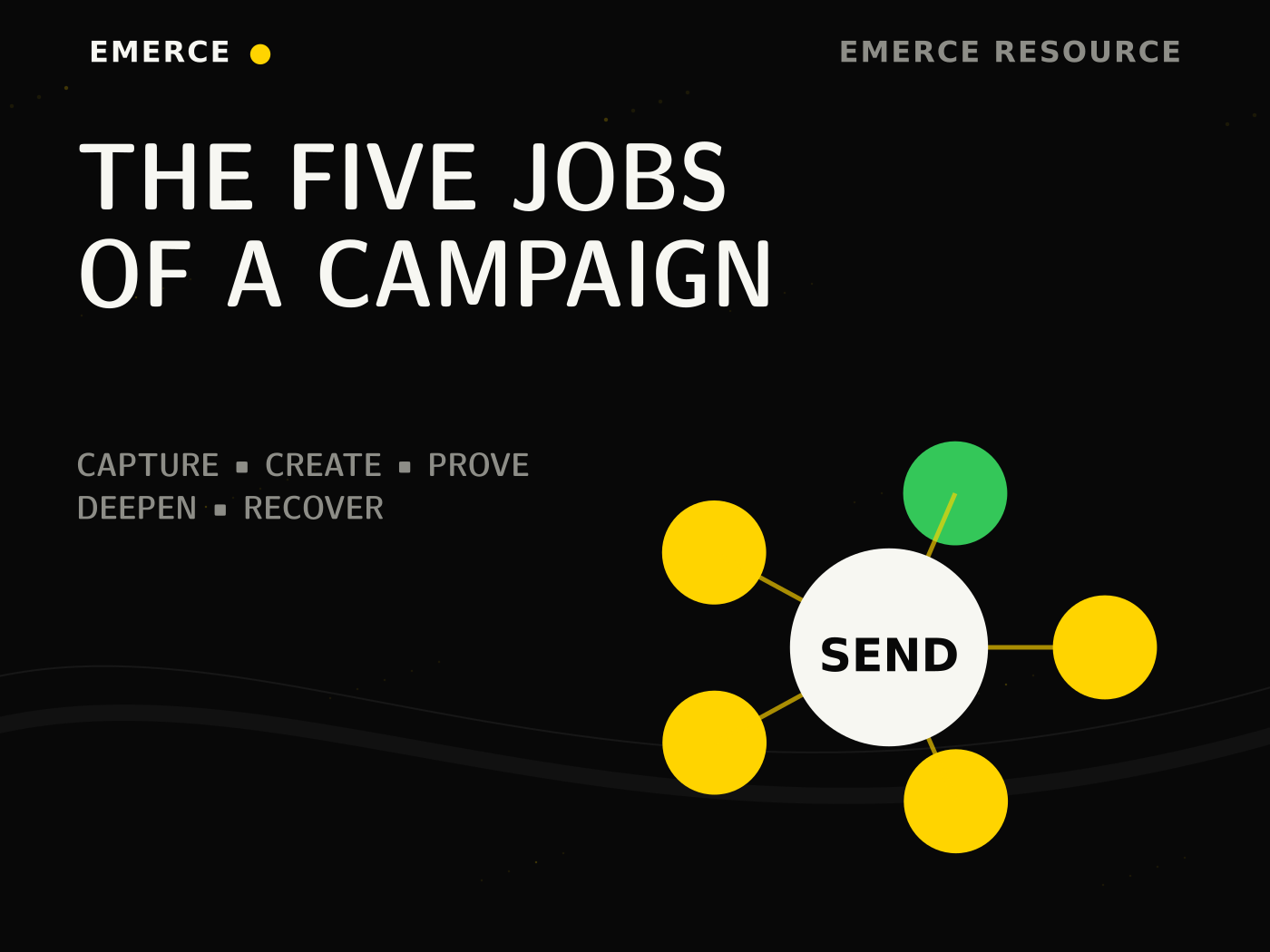
A strong campaign calendar normally needs five kinds of work:
- Capture demand that already exists.
- Create demand that does not exist yet.
- Reduce the friction stopping a purchase.
- Deepen the relationship after attention or purchase.
- Recover or qualify attention that is fading.
Your exact mix will change with launches, seasonality, inventory, and customer behavior. The useful part is that every send has a reason to exist. “It was Thursday” does not count, even if the calendar cell was very persuasive.
A content calendar is not a campaign strategy
Most ecommerce calendars are assembled from dates and offers:
- Tuesday: product email
- Thursday: promotion
- Sunday: last chance
That tells the team when work is due. It does not explain what the work is supposed to change.
When the job is unclear, campaigns drift toward the easiest available idea. Usually that means another promotion, a generic bestseller roundup, or a second version of last week's promotion wearing a different subject line.
A portfolio prevents that drift. It gives the calendar a deliberate mix of commercial roles instead of asking every email to close the sale immediately.
The five campaign jobs
1. Capture active demand
Give customers who are already close to buying a credible reason to act now.
2. Create future demand
Help customers understand the problem, product, use case, and difference.
3. Reduce decision friction
Answer the practical question standing between interest and purchase.
4. Deepen the relationship
Make the brand and the purchase more useful between buying moments.
5. Recover or qualify attention
Run a finite reactivation effort, then stop treating silence as an audience.
1. Capture active demand
Some customers are already close to buying. A campaign can help them act while the interest is fresh.
Useful campaign types include launches, restocks, category spotlights, low-inventory moments, relevant promotions, replenishment reminders, and messages tied to recent browsing or purchase behavior.
These campaigns harvest demand. They work best when there is a credible reason for the message to arrive now.
The mistake is treating every campaign as though the entire list has active demand. A launch may deserve broad reach. A narrow category restock probably does not. Campaign job and recipient choice belong in the same decision.
2. Create future demand
Customers do not always arrive knowing which product they need, why it is different, or why it deserves a place in their budget.
Demand-creation campaigns explain the problem a product solves, how it works, who it is for, useful routines, material choices, comparisons, care, setup, fit, or compatibility.
These sends may not win the weekly revenue leaderboard. That is not the same as being uncommercial.
They give later launches, reminders, and promotions more context to work with. Product education compounds because the next commercial message lands on a customer who understands more than they did before.
3. Reduce decision friction
Interest is not the same as confidence.
A customer may want the product and still hesitate because a practical question is unresolved. Friction-reduction campaigns answer the question standing between attention and purchase.
Use customer reviews, fit or compatibility guidance, delivery and returns explanations, product comparisons, objection handling, guarantees, warranties, and genuine before-and-after evidence.
This is where many brands reach for a discount too early. If the customer is worried about fit, ten percent off does not answer the fit question. It simply makes the uncertainty slightly cheaper.
4. Deepen the relationship
Not every useful campaign should push an immediate product decision.
Relationship-deepening campaigns make the brand more useful after the first click or purchase. They can include product-use education, customer stories, thoughtful founder notes, care guidance, brand decisions that matter to the buyer, community content, and credible early access.
The standard is not “send something non-promotional.” The campaign still needs a job. The job is to strengthen understanding, usefulness, trust, or belonging so the next commercial message is not arriving cold.
5. Recover or qualify fading attention
Some subscribers are no longer responding. Routine campaigns should not continue indefinitely just because the profile remains marketable.
Use a defined reactivation campaign or sequence to learn whether interest still exists. Give the customer a clear reason to stay, make preference choices easy, and stop regular campaign pressure if meaningful engagement does not return.
Recovery has two valid outcomes: attention returns, or the program stops pretending that silence is an audience.
Build the monthly portfolio
Use the five jobs as columns in your planning sheet. Then work through the month in this order.
- 01
Add fixed commercial moments
Start with genuine launches, inventory events, seasonal deadlines, and major promotions. These usually sit in capture-demand.
- 02
Identify the customer decisions around them
What must customers understand before the event? What concerns could delay purchase? Add education and friction-reduction campaigns before the commercial moment, not as an apology afterward.
- 03
Protect relationship value
Add useful post-purchase, education, or brand-led content where the calendar would otherwise become one long demand for money.
- 04
Isolate reactivation
Reactivation belongs with fading audiences. It should not become a full-list campaign angle.
- 05
Check the weighting
Count how many campaigns do each job. There is no universal ideal ratio. The diagnosis comes from imbalance.
If nearly every campaign captures demand, the calendar may be living on launches and discounts. If it creates demand but rarely gives customers a path to buy, it may be interesting but commercially shy. If every send tries to deepen the relationship, the brand has invented a pleasant newsletter and forgotten the shop.
Balance does not mean equal shares. It means the mix reflects the actual work the business needs.
Measure campaigns by job
Do not expect every campaign job to produce the same pattern of results.
For capture-demand campaigns, conversion and revenue per recipient matter heavily. For demand-creation campaigns, qualified clicks, product-page engagement, and assisted conversion may tell more of the story. For friction-reduction sends, look for movement into high-intent actions. For relationship content, pay attention to repeat engagement and downstream response. For reactivation, the useful result is the number of people who show credible renewed interest—and the number you can confidently remove from regular sends.
Use consistent campaign tags so these roles can be compared over time. A campaign portfolio becomes more valuable when it creates structured learning, not just a tidier calendar.
A simple campaign brief
Before approving a campaign, write down five things:
- Job: Which of the five jobs is this doing?
- Audience: Who has a credible reason to care now?
- Decision: What should the customer understand, believe, or do?
- Proof: What product detail, evidence, or offer supports the message?
- Measurement: Which result would show that the campaign did its job?
If those answers are weak, the problem is not the header design.
Build a calendar that can learn
The best ecommerce campaign calendars do more than keep production moving. They balance short-term demand with the work that makes future demand easier to capture.
Use the five-job portfolio to see what your calendar is overusing, what it is neglecting, and what the next campaign actually needs to accomplish.
Need a starting point? Use our free email campaign ideas planner to find an angle for your next send, choose an audience, and download a plan.
The Inbox Operating System™
Give every campaign a job before production starts.
Build the planning and decision structure for choosing what to send, who should receive it, how frequently to send, and how to measure the result.
Get the operating systemFAQ
How many ecommerce email campaigns should a brand send each week?
There is no universal number. Set frequency by audience engagement, message quality, buying cycle, and marginal response. The portfolio decides what work needs doing; recipient eligibility decides who receives each opportunity.
What should I send besides promotions?
Use product education, comparisons, objection handling, reviews, product-use guidance, customer stories, launches, restocks, and reactivation. Choose the format after defining the campaign's job.
Should every campaign have a sales CTA?
No. The action should match the job. Commercial clarity matters more than forcing the same button into every message.
Sources