
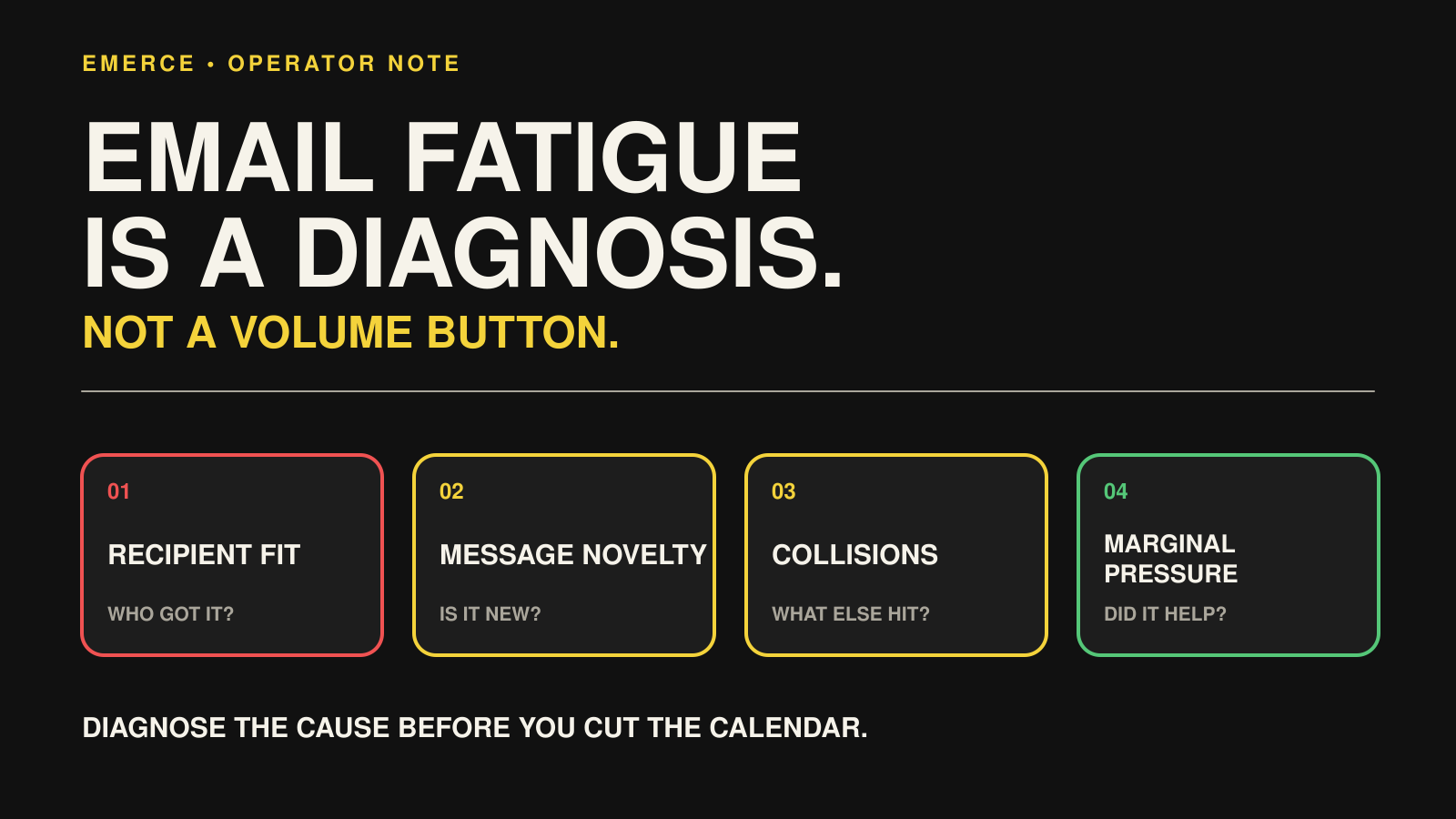
Email fatigue shows up when customers receive more messages than they find useful.
Volume matters. But the first diagnosis should not be “send less to everyone.” It should be:
- Are we sending the wrong message to the wrong people?
- Are recent campaigns repeating the same idea?
- Are campaigns and flows colliding at the profile level?
- Did the next send add useful response or mainly add pressure?
Cutting volume can reduce the symptom. If relevance, repetition, or audience selection is the real problem, the program will simply send fewer uninteresting emails.
What email fatigue looks like
Do not diagnose fatigue from one weak open rate.
Look for a pattern across several sends and several types of response:
- declining unique click rate
- fewer repeat clickers
- weaker conversion after the click
- rising unsubscribes or spam complaints
- a shrinking engaged audience
- a larger share of revenue concentrated in a smaller group
- customers receiving campaigns and automated messages too close together
- subject lines and content becoming increasingly promotional or repetitive
Open rate can be useful directionally, but privacy-related opens mean it needs qualification. Klaviyo recommends checking the whole performance chain when KPIs fall: delivery, opens, clicks, conversion, and revenue.
Why volume gets blamed first
Volume is visible. A calendar shows five campaigns instead of three, so it looks like a clean cause with a clean fix.
The customer experience is messier.
One subscriber may receive two relevant messages and welcome both. Another may receive a campaign, a browse reminder, an abandoned-cart email, a post-purchase cross-sell, and an SMS inside forty-eight hours. The calendar says “two campaigns.” The customer says something less printable.
Fatigue happens at the profile level, not in the planning meeting.
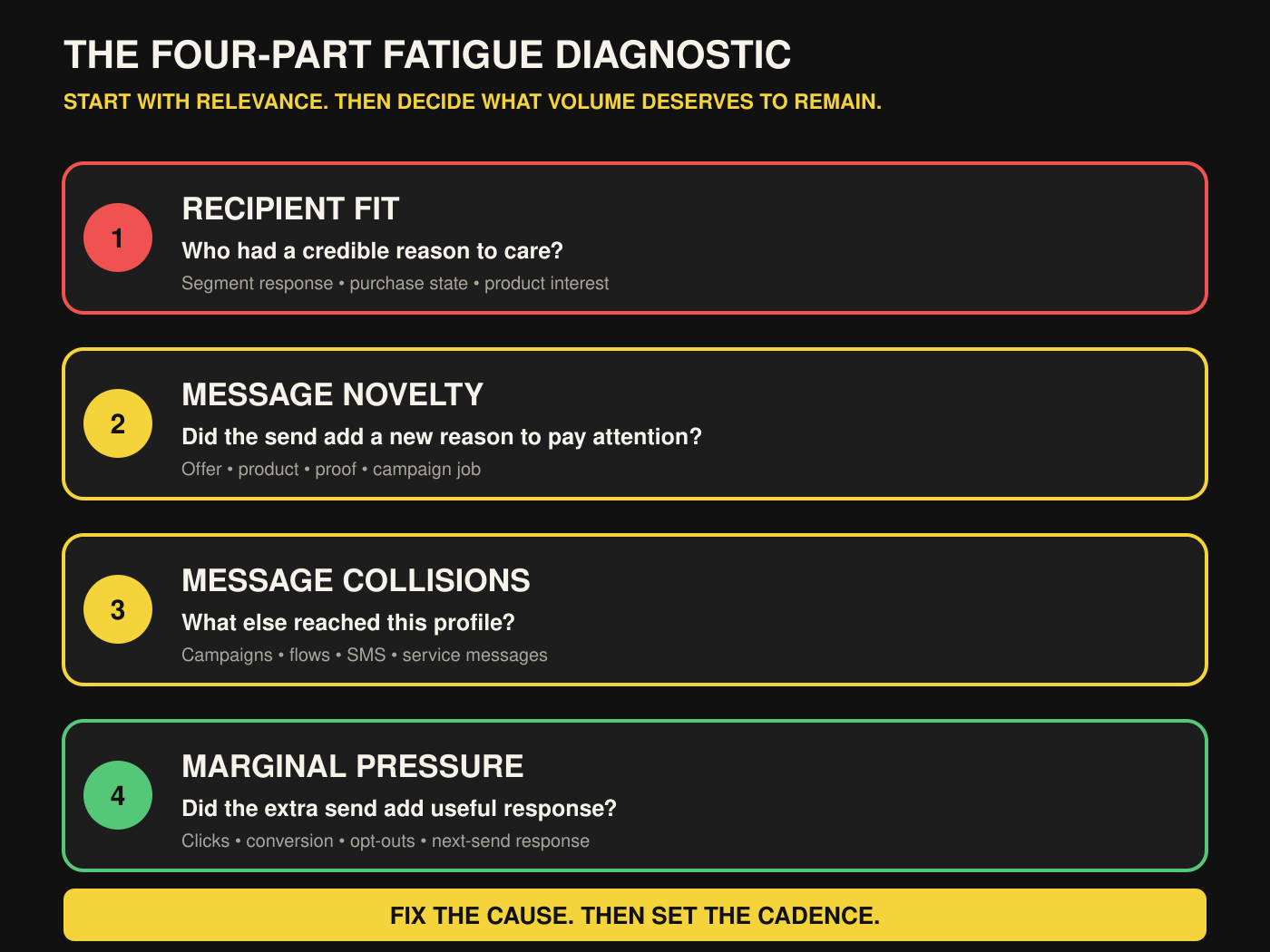
The four-part fatigue diagnostic
1. Recipient fit
Ask whether each campaign reached people with a credible reason to care.
Inspect performance by engagement tier, customer status, product interest, and purchase behavior. If the active segment still responds while cooling audiences fall away, the problem may be eligibility rather than total calendar volume.
Klaviyo’s current guidance recommends different sending tracks for different engagement levels. That gives active customers more room while reducing pressure on less responsive profiles.
Practical questions:
- Which segment created most of the useful clicks and orders?
- Which segment created most unsubscribes and complaints?
- Did customers outside the relevant category receive the message?
- Did recent buyers receive an inappropriate promotion?
- Were dormant profiles included because the campaign “felt important”?
If they ignored the last twelve campaigns, number thirteen probably is not the relationship breakthrough.
2. Message novelty
Customers can tire of repetition even when the number of sends stays flat.
Review the last month at thumbnail level. How many campaigns used the same offer, product set, argument, proof, and deadline language?
Change the job, not just the header.
A healthier portfolio moves between demand capture, product education, friction reduction, customer proof, relationship value, and deliberate reactivation. Repeating a promotion with a new background color is still repetition. The inbox has excellent color vision.
Practical questions:
- Did each campaign introduce a new reason to pay attention?
- Are several sends harvesting the same demand?
- Has product education happened before the promotion?
- Are “last chance” emails arriving for events customers never noticed in the first place?
3. Message collisions
Campaign calendars rarely show the complete pressure an individual receives.
Overlay campaign eligibility with active flows and other channels. Check welcome, browse, cart, post-purchase, replenishment, win-back, SMS, and transactional activity.
Klaviyo’s Smart Sending can limit how many marketing messages a person receives inside a set period. It is useful protection when campaigns and flows overlap. It is not a substitute for deciding which communication should win.
Create a simple precedence rule:
- Transactional and service messages
- High-intent behavioral messages
- Time-sensitive, customer-relevant campaigns
- Routine campaigns
- Reactivation
The exact order may change by business. What matters is that collision handling is deliberate.
4. Marginal pressure
Finally, examine what happened when volume changed.
Do not only compare total weekly revenue. The extra send may redistribute purchases that would have occurred through another campaign or flow.
Review:
- incremental clicks and conversions where testing allows
- revenue per recipient by audience tier
- unsubscribe and complaint changes
- future response from recipients of the extra send
- movement between active, warm, cooling, and dormant tiers
If the additional campaign creates useful response from active audiences without worsening negative signals, the volume may be supportable. If it mainly reaches cooling contacts and weakens their later response, the better fix is narrower eligibility—not necessarily a smaller calendar for everyone.
When volume really is the problem
Sometimes the diagnosis is straightforward: customers are receiving too much.
Reduce or redistribute volume when:
- strong audiences show broad decline across distinct content types
- unsubscribes or complaints rise after additional opportunities
- Smart Sending or collision analysis reveals heavy profile-level clustering
- marginal campaigns add little response
- the content portfolio cannot support the cadence with genuinely different messages
- customers receive several channels without a coordinated pressure rule
Google’s current sender guidance says to keep the user-reported spam rate in Postmaster Tools below 0.10% and avoid ever reaching 0.30% or higher. Those are deliverability guardrails, not performance targets—or a particularly inspiring place to aim.
A practical four-week test
Week 1: establish profile-level pressure
Measure messages received per person, not just campaigns sent. Include major automated flows and SMS where relevant.
Week 2: label campaign jobs and audiences
Tag each send by campaign job, engagement tier, and product relevance. Look for overused ideas and weak recipient logic.
Week 3: change one variable
For one audience tier, change eligibility, cadence, or collision handling. Do not change all three and then congratulate the dashboard for being mysterious.
Week 4: compare both horizons
Measure immediate response and the next-send response. Watch clicks, conversion, unsubscribes, complaints, and tier movement.
Keep, reverse, or refine the change based on the full pattern.
Better targeting can earn more frequency
The answer to fatigue is not always fewer campaigns.
A broad calendar may be sustainable when individual campaigns reach the people most likely to value them. Active customers can receive more relevant opportunities while cooling audiences receive fewer, stronger messages. Dormant profiles can move into a finite reactivation path instead of absorbing routine pressure forever.
Relevance does not make volume free. It makes frequency something the audience can earn through behavior and the brand can justify through useful content.
Diagnose before you cut
When engagement weakens, inspect recipient fit, message novelty, collisions, and marginal pressure before reducing volume across the board.
You may still decide to send less. The difference is that you will know which audience needs less, which messages need to disappear, and which useful campaigns deserve to remain.
Email Revenue Operating Audit
Find the part of your email program that needs attention first.
Review what you send, who receives it, how frequently you send, and how you measure it. The lowest-scoring area becomes the next 30-day priority.
Run the free auditFAQ
What causes email fatigue in ecommerce?
Common causes include excessive profile-level frequency, irrelevant targeting, repetitive campaign ideas, collisions between campaigns and flows, and weak message value. Diagnose the pattern across clicks, conversion, unsubscribes, complaints, and audience movement.
Should I reduce email frequency when engagement drops?
Possibly, but first isolate the audience, content, and collision pattern. If active segments still respond, reduce eligibility for weaker tiers before cutting the entire calendar. If strong audiences decline across distinct messages, broader volume reduction may be warranted.
Can Smart Sending prevent email fatigue?
It can reduce close-together marketing messages, but it does not decide which message is most relevant or fix repetitive content. Use it as a guardrail inside a wider campaign and flow pressure strategy.
For more context, see the email frequency guide, engagement ladder, campaign portfolio, and product-led versus promotion-led guide.
Sources