
There is no universally correct number of emails an ecommerce brand should send each week.
The better question is:
How much email pressure should each part of your audience receive right now?
One list-wide frequency treats your most engaged customer, a casual browser and a subscriber who has ignored you for six months as though they have the same level of interest. They do not.
Email frequency is a pressure-allocation decision
Every campaign asks something from the recipient: attention, time, a click or a purchase. That means every campaign applies commercial pressure.
If you send four campaigns this week, the decision is not simply whether four is too many. It is who receives all four, who receives only the two most relevant, who receives one carefully chosen message—and who should receive none.
The three signals that decide frequency
1. Engagement quality
Look beyond opens. Give more weight to recent clicks, site activity, product views, added-to-cart activity, purchase recency and repeat purchase behavior. The stronger and more recent the signal, the more opportunities you can reasonably test.
2. Negative response
Watch for unsubscribes, spam complaints, falling click activity and disengagement across consecutive sends. These are operating costs, not footnotes beneath the revenue number.
3. Marginal response
Ask what happens when you add or remove the next campaign. If an additional send creates incremental clicks and conversions without materially weakening audience health, that audience may support it. If the send merely spreads the same demand across more campaigns, you added volume—not performance.
A practical engagement ladder
These tiers are starting guardrails, not universal rules. Category, buying cycle, seasonality, list source and campaign quality all change the answer.
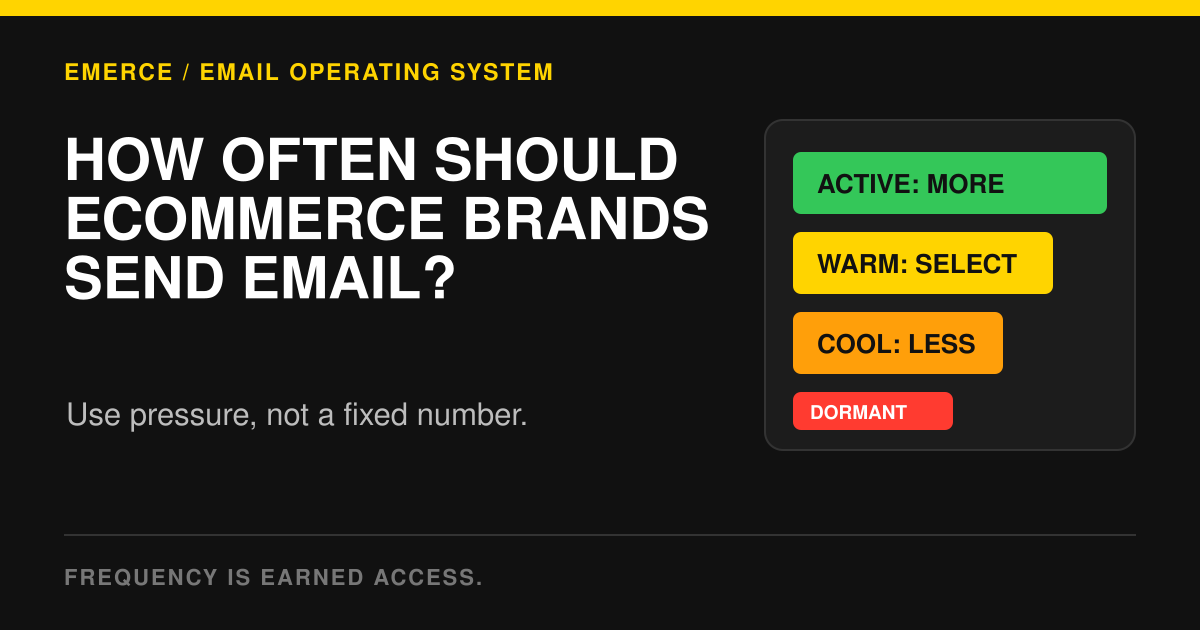
Tier 1 · Active intent
Recent clickers, active browsers, recent buyers and people consuming high-intent product content.
Test the broadest campaign set. Three to five distinct opportunities per week can be reasonable when response remains healthy.Tier 2 · Warm engagement
People with meaningful but less recent or less commercial engagement.
Prioritize the strongest two or three weekly campaigns: product education, proof and commercially relevant moments.Tier 3 · Cooling
Subscribers without a recent click, browse or purchase signal strong enough to justify full pressure.
Reduce frequency to the strongest weekly message or a more selective cadence. Use each send to learn whether interest remains.Tier 4 · Dormant
Contacts with no useful recent engagement.
Remove them from routine broadcasts. Use a defined reactivation test, then suppress contacts who still do not respond.How to set your sending frequency
- 01
Establish the baseline
Review six to eight weeks of messages received per subscriber tier, then record clicks, conversion, revenue per recipient, unsubscribes, complaints and engaged-audience size.
- 02
Create engagement tiers
Start with the strongest signals available in your stack. Add site and purchase behavior as your data quality improves.
- 03
Assign campaign eligibility
Decide which tiers have earned each send. This is where a content calendar becomes an audience plan.
- 04
Change one tier at a time
Adjust weekly opportunity count for one audience. Compare marginal response with its prior baseline and a holdout where possible.
- 05
Keep, reverse or refine
Keep useful incremental response. Reverse harmful pressure. Refine the recipient rule when the result is mixed.
What to measure besides revenue
Commercial response
Conversion, revenue per recipient, contribution and incrementality.
Engagement quality
Unique clickers, site activity and repeat engagement across sends.
Audience health
Unsubscribes, complaints, bounces and engaged-audience movement.
The answer
Send as often as each audience tier can support useful, distinct messages without a material decline in engagement quality or audience health.
That will rarely be one number for the whole list. Frequency is not a calendar preference. It is earned access to attention.
The Inbox Operating System™
Build the rest of the operating system.
Make better decisions across what you send, who receives it, how frequently you send and how you measure performance.
Get the system for $37Frequently asked questions
Email frequency FAQ
Is sending ecommerce email every day too much?
Not automatically. Daily sending can work for a highly engaged audience receiving distinct, relevant messages. It can also create unnecessary pressure when the same full list receives every campaign.
How many marketing emails per week should an ecommerce brand send?
There is no universal number. Start with engagement tiers, assign campaign eligibility and judge the next send by its marginal commercial response and effect on audience health.
Should inactive subscribers receive fewer emails?
Usually. Persistently inactive subscribers should receive a more selective cadence, a deliberate reactivation sequence or suppression—not every routine broadcast.
Does sending more email hurt deliverability?
Volume alone is not the answer. Sending more irrelevant email can increase negative response and weaken engagement signals. Earn additional opportunities through relevance and audience selection.