
Product-led and promotion-led emails solve different problems.
A product-led email builds the case to buy. It explains the product, sharpens the use case, reduces uncertainty, or makes the value easier to see.
A promotion-led email changes the economics or timing. It gives the customer a financial or deadline-based reason to act now.
Neither is automatically better. Trouble starts when a brand uses a promotion to solve a product-understanding problem—or spends three weeks explaining a product to an audience that already wants it and simply needs a credible buying moment.
What product-led email does
Product-led campaigns help customers answer questions such as:
- Is this relevant to me?
- Why is it different?
- How would I use it?
- Which option is right?
- Will it fit, work, last, or solve the problem?
- Why is it worth the price?
Useful formats include demonstrations, use cases, comparisons, material stories, FAQs, reviews, fit guidance, buying guides, and product-specific customer stories.
The product remains the center of the argument. A discount may appear, but the email does not depend on it to make the product interesting.
What promotion-led email does
Promotion-led campaigns make the offer the primary reason to act. The message may lead with:
- a temporary price reduction
- free shipping
- a gift with purchase
- a bundle
- loyalty or VIP access
- a seasonal event
- a credible inventory or deadline constraint
Promotions are good at concentrating attention. They can create a clear event around a launch, speed up a decision, move inventory, reward a group, or give a cooling customer a reason to reconsider.
They also have a cost. Margin is the obvious one. Less obvious is the learning you create. If customers repeatedly see that waiting produces a better price, some of them will quite reasonably wait.
Research on promotions does not support one simple rule. A large Alibaba field experiment found that promotional effects can differ between short- and longer-term behavior, while other pricing research shows promotions affect customers through economic, informational, and emotional routes. Emerce's operating conclusion is modest: treat a promotion as an intervention with a defined job, not as neutral decoration on the calendar.
The demand-state rule
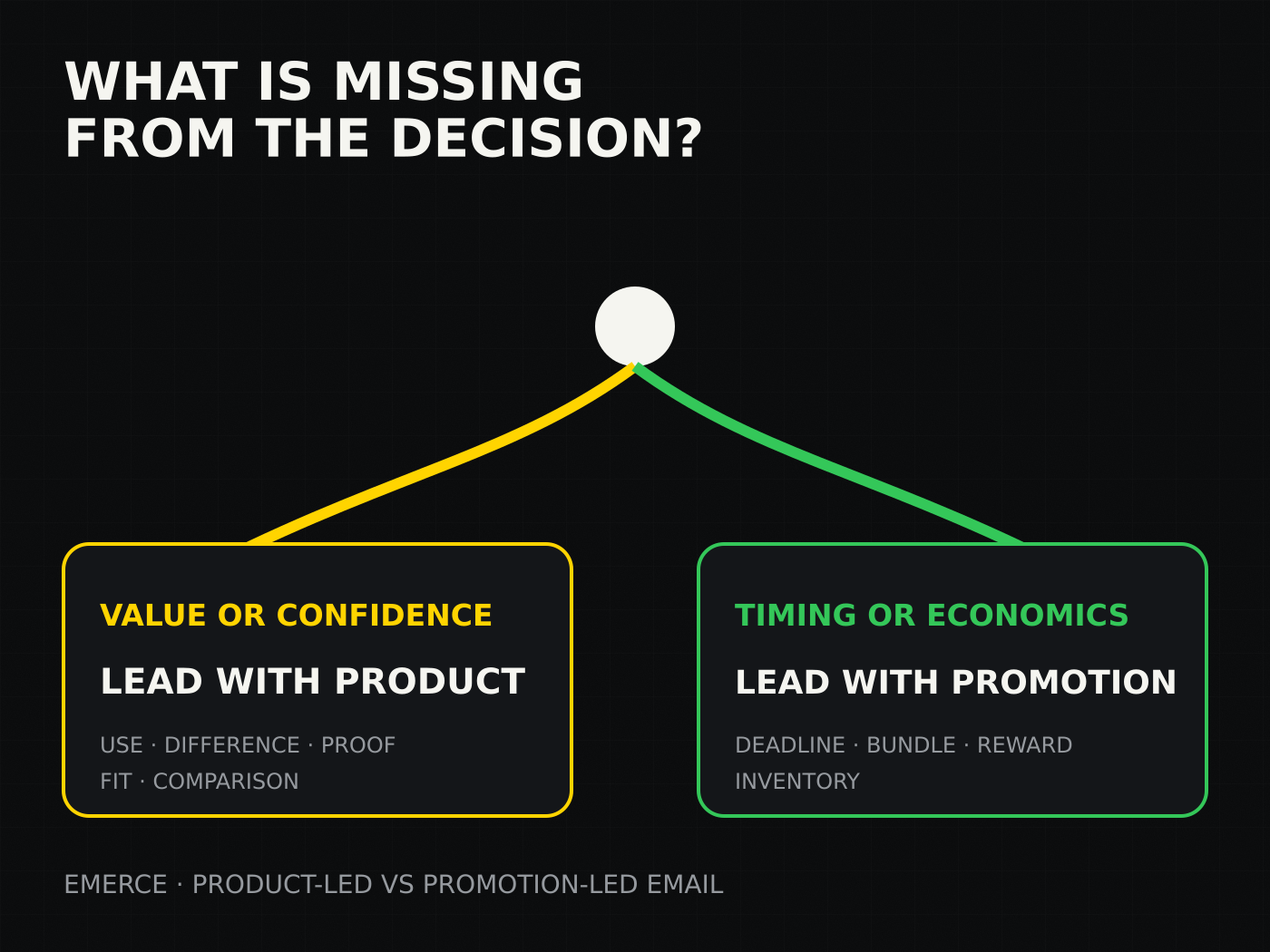
Ask what is missing from the customer's decision.
Use product-led email when value or confidence is missing
Choose product-led content when customers need to understand the product, distinguish options, imagine the use case, or resolve practical uncertainty.
Signals may include:
- product-page traffic without deeper action
- repeated questions about fit, compatibility, use, or materials
- strong click interest but weak conversion
- a new or unfamiliar product category
- a considered purchase that naturally needs education
- a full-price product with a strong story that has not been told well
If customers do not understand why the product is worth buying, lowering the price may lift a campaign without fixing the underlying problem.
Use promotion-led email when timing or economics is the real barrier
Choose a promotion when the product case is already clear and there is a legitimate reason to change the buying moment.
Examples include:
- a defined seasonal event
- a margin-aware customer-acquisition test
- excess or aging inventory
- a bundle that improves the customer outcome
- a VIP or loyalty reward
- a targeted win-back offer
- a deadline customers can understand and trust
Write down the commercial job before selecting the discount. “We need revenue this week” is a business need, but it is not yet a promotion strategy.
Five questions before discounting
1. What behavior are we trying to change?
Are you accelerating an already likely purchase, reviving lapsed demand, moving a specific category, increasing basket size, or acquiring a new customer?
If the intended behavior is vague, the offer will be difficult to judge.
2. Which audience needs the intervention?
A full-list discount gives the margin away to customers who may have bought without it. Start with the group whose behavior or status makes the offer relevant.
Klaviyo supports segments based on activity, purchase history, and customer value. The useful part is not the feature itself. It is the discipline of matching the offer to evidence. The engagement ladder is a practical starting point for that audience decision.
3. Is price really the barrier?
Look at questions, product-page behavior, reviews, returns, customer-service themes, and prior campaign response.
If the obstacle is uncertainty, improve the product case. If the obstacle is timing or affordability, a promotion may be appropriate.
4. What will this teach customers?
One sale does not create a discount-dependent audience. A predictable pattern can.
Review how often the category has been discounted, whether sale periods are becoming more frequent, and whether full-price response is weakening between them. Then use audience behavior—not a blanket number—to decide how often to send.
5. How will we know it worked?
Measure more than attributed revenue. Include contribution after discount, revenue per recipient, new versus existing customer behavior, category movement, unsubscribes, and response after the event.
A promotion can look excellent inside the campaign report and less impressive once margin and displaced future demand join the meeting.
Product-led and promotion-led can work together
The best commercial sequences often use both, in the right order.
- Explain the product problem and use case.
- Show proof, comparison, or practical guidance.
- Introduce a genuine buying event.
- Remind only the audiences still eligible and interested.
Now the offer accelerates informed demand instead of trying to manufacture interest from nothing.
The reverse can also work. A promotion earns the first click, while the body of the email uses product detail and proof to convert it. The key is knowing which element is doing which job.
Audit your last month
Label each campaign as:
- primarily product-led
- primarily promotion-led
- deliberately hybrid
Then add three fields:
- the customer barrier it addressed
- the audience it targeted
- the result you expected
Patterns become visible quickly. You may find that discounts are doing most of the calendar's work. You may find product education exists, but it arrives after the sale rather than before it. You may find every hybrid campaign is really a promotion with two product bullets attached for moral support.
Use the audit to rebalance the next month around customer decisions, not a fixed ratio. The five-job campaign portfolio can help turn that diagnosis into a broader calendar.
The decision
Stuck for an idea that does not need a discount? Try our free email marketing ideas planner and select “No discounts” for product, education, and other campaign angles.
Choose product-led email when customers need a stronger reason to want the product or more confidence to buy it.
Choose promotion-led email when the product case is understood and a commercial intervention has a defined job.
Use both when education should build the demand and an honest buying event should concentrate it.
Discounts are useful. They are simply too expensive—financially and behaviorally—to use because the calendar looked empty.
The Inbox Operating System™
Give every campaign a job before production starts.
Build a repeatable decision process for what to send, who should receive it, how often to send, and how to measure the result.
Get the operating systemFAQ
Are promotional emails bad for ecommerce brands?
No. Promotions can accelerate demand, move inventory, support acquisition, reward customers, and create clear commercial events. They become a problem when they are used without a defined audience, margin logic, or customer behavior to change.
How often should an ecommerce brand run a sale?
There is no universal cadence. Base the decision on margin, inventory, customer expectations, category behavior, and response between sale periods. Review whether promotions are becoming necessary to produce normal demand.
What is a product-led ecommerce email?
It is an email where product value, use, proof, or differentiation is the main reason to engage. The message helps the customer understand why the product belongs in their life rather than relying mainly on a temporary price.
If you want to find the weakest part of the wider program first, run the free Email Revenue Operating Audit.
Sources